Private Caregiver Resume Examples for Home Care Jobs
When you are searching for a private caregiver job your work starts before the interview. It starts with your resume.
Most recruiters reject caregiver CVs before a human reads them. They don’t pass the ATS, don’t perform essential duties, or fail to meet formatting expectations. This guide fixes all of that.
Here you find real caregiver resume examples with a skills breakdown and also have ATS formatting rules. It gives you the most common mistakes to cut before you apply.
What Other Get Wrong About Caregiver Resumes
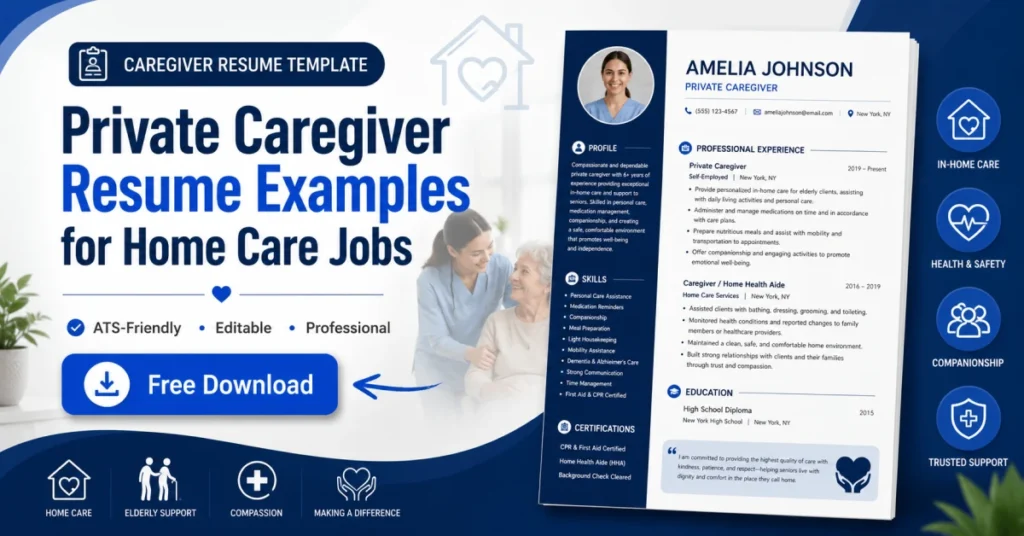
We analysing the top-ranking for private caregiver resume examples, a few gaps stand out:
Missing responsibilities: Most people skip dementia protocols, emergency response documentation, and end-of-life support. Employers frequently include it in private caregiver job descriptions.
Weak ATS keyword coverage: Most people focus on generic terms like “patient care” and “compassionate.” Recruiters and ATS systems also scan these terms of keywords in the resume: “personal care assistant,” “activities of daily living,” “medication administration,” “care plan compliance,” and “safeguarding.”
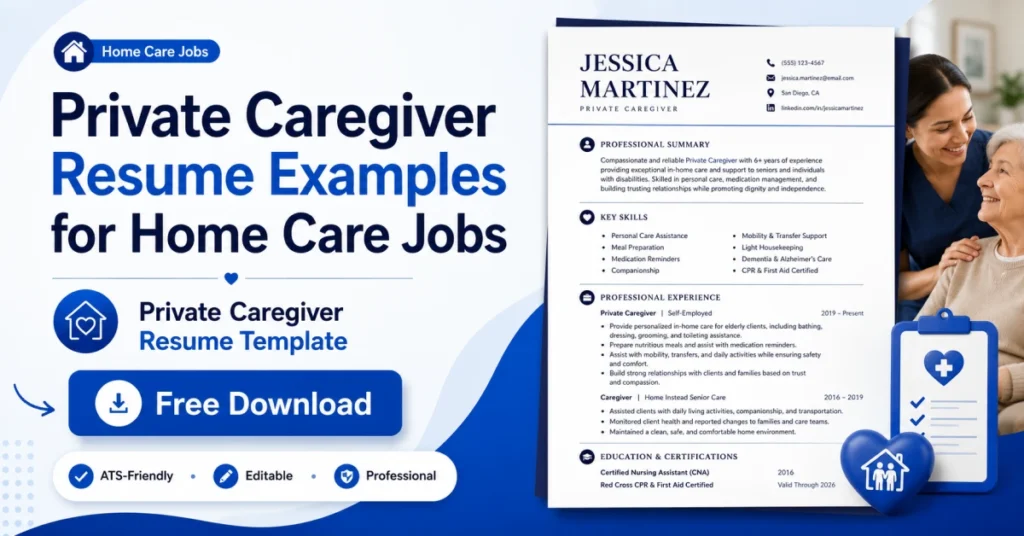
No formatting depth: A lot of people present a resume picture without giving an explanation about why this format is effective. All job seekers copy formats without understanding their purpose.
What to Include in Your Caregiver Resume
There are typical structure components of a strong caregiver resume. The standard layout that easily passes most ATS filters includes:
- Header: Full name, phone number, email, city/postcode
- Professional Summary: 2–3 lines, role-specific, keyword-rich
- Core Skills: Bullet list, 8–12 items, matched to the job ad
- Work Experience: Reverse chronological, achievement-focused
- Certifications: First Aid, Manual Handling, DBS check, NVQ
- Education: Qualification, institution, year
Just limit your resume to one page if you have less than 10 years experience. Two pages work well for senior carers with specialised backgrounds.
Skills to Add to Your Caregiver CV
Employers hiring for private caregiver jobs expect both hard and soft skills. Generic lists waste space. Use skills that appear directly in home care job descriptions.
Hard skills to include:
- Record and administer medication
- Personal hygiene and help with bathing
- Cooking and food monitoring
- Care of the catheter and stoma
- Mobility support and hoisting
- Dementia and Alzheimer’s care
- The protection and risk assessment. The protection and risk assessment.
- Compliance with and documentation of care plans
- First Aid (with First Aid certification date)
- Medical treatment at the end of life and palliative care. Support for end-of-life and palliative care.
Soft skills that actually matter:
- Temperament and emotional strength
- Effective dialogue with families and GPs
- Managing time on multiple clients
- Professional boundaries/discretion
Don’t fill out your skills section. Only put these terms which support you in the interview.
How to Format a Caregiver Resume for ATS
The majority of home care employers use ATS. An ATS will read your resume before a human. If it cannot read your layout, the system automatically filters you out.
Follow these rules for a proper ATS resume template:
- Employ standard headings for sections: Work Experience, Skills, Education, Certifications
- Do not use tables, columns, headers, footers or text boxes. ATS parsers ignore these.
- Have a simple single column design with clear white space
- Save file as .docx or PDF as needed by the job ad
- Don’t use synonyms for the words in the job description; use the words themselves!
A minimalist ATS resume template is your safest choice. Fancy design doesn’t add anything in it and risks breaking the scan. If you want a template that is proven to pass ATS checks, this Minimalist ATS Resume Template from Creative Fabrica is a perfect starting point.
Common Caregiver Resume Mistakes to Avoid
These errors appear consistently across rejected home care resumes:
Using a photo. In the UK, it is not formal to include a photograph and employers develop unconscious bias because of it so, leave it out.
Generic summaries. If you write “Dedicated and compassionate carer seeking a rewarding role” this tells nothing to the recruiter. So write it in this way : “Experienced private caregiver with four years supporting adults with dementia and post-operative needs, DBS checked and NVQ Level 2 qualified.”
Missing certifications. You have to Clearly highlight DBS clearance, First Aid, Manual Handling and NVQ/QCF qualifications. A lot of applicants write these in the bottom of a wall of text.
Spelling errors. Healthcare employers view typos as a red flag. A careless resume suggests careless documentation on the job.
Outdated work experience at the top. Write everything in reverse-chronological order. The last role you had is first.
Final Tips for Your Home Care Resume
Your caregiver resume needs to do two things. First pass the ATS scan and persuade the hiring manager. Most candidates optimize for one and forget the other.
Always use the above structure. It includes role-specific keywords from the job description, and keeps your formatting clean. If you are applying for nursing or clinical roles too, check out the Nurse Resume Template guide on Resume-Template.net for healthcare-specific formatting advice.
Last but not least, customize each application. A private carer role with live-in care is different from a domiciliary care role. Pay close attention to the job description, use the language and phrases used in the job description and revise your summary each time you apply for a position.
A well-written caregiver CV is not just a document. It is the first impression you make. Make it count.

Aleena Amin
This article was written by Aleena Amin. Explore more posts from this author for helpful insights and resources.