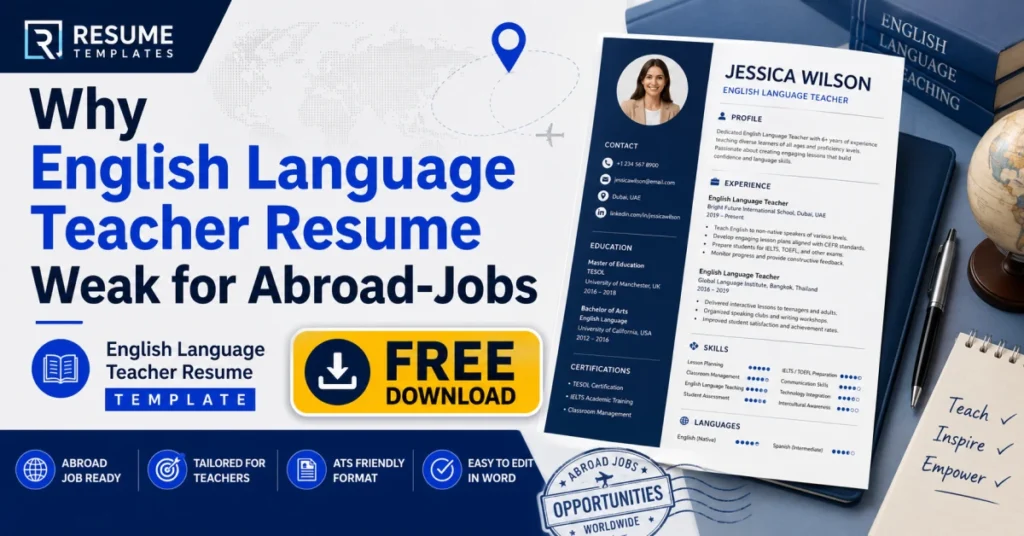
Why English Language Teacher Resume Weak for Abroad-Jobs
Find out why your English Language Teacher Resume fails international jobs. Learn what hiring managers look for and how to fix your CV fast today.
If you have all things like the qualifications, classroom hours and real experience working with students but you get nothing when you apply for an international teaching role. No callback. No interview. Just silence.
The problem is rarely about your teaching ability. In most cases, it is about one thing. Your English Language Teacher Resume is not doing the job.
Schools abroad, language schools and global education companies receive several hundred applications. They narrow it down quickly, and they turn down quickly! They immediately see something in your CV if it doesn’t, and they send it in the bin.
Here is exactly why you’re not getting the responses you’re looking for on your resume.
Why Does Your English Language Teacher Resume Lacks a Clear Professional Summary
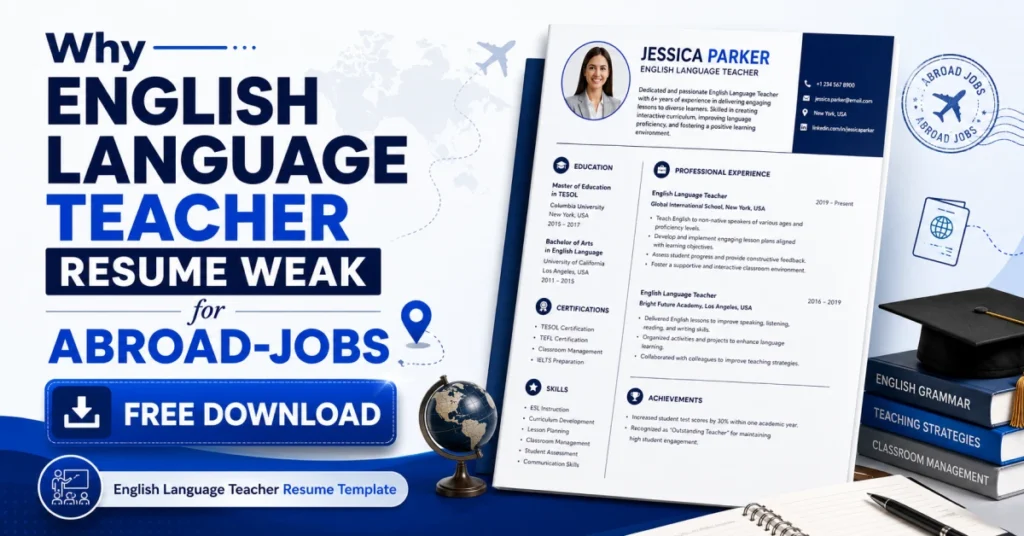
Most teachers don’t write a summary or they write something that is too generic. A word about a “passionate educator with a love for language” those are words of no use to anyone who hires you.
Your summary should be comparable to a pitch. It must include your experience level, the ages you teach or the skill levels you teach, any teaching specialisms (e.g. preparation for IELTS exams or business English) and availability to move. Keep it to three or four lines. Make every word count.
Why Are Your Certifications Not Showing Clearly?
International employers check for certification first and foremost. You place your TEFL, TESOL or CELTA certificates somewhere in the middle of your CV, and you lose points immediately.
Certifications That Matter to International Schools
Various positions require different skills. These are the most known and accepted ones and have global significance:
• CELTA (Certificate in English Language Teaching to Adults)
• DELTA (Diploma in English Language Teaching to Adults)
• TESOL (Teaching English to Speakers of Other Languages)
• TEFL (Teaching English as a Foreign Language)
• Trinity CertTESOL
• QTS (Qualified Teacher Status) valued in British curriculum schools abroad
Identify each certification using the full name, certifying organization, and the year of the certification. If done online, still submit it, but be sure the provider is recognised.
Why Does Your Work Experience Sound Weak?
This is one of the biggest mistakes English teachers make. If you write “taught grammar and vocabulary to B2 students” tells the reader what you did — but not how well you did it.
International employers are looking for results. They want to know about students who passed their examinations. It increased their scores or achieved a certain level of achievement with your instruction.
Always use numbers where it is possible. For example: “Prepared 24 students for IELTS; 19 achieved a band score of 6.5 or above.” That single line is far stronger than a paragraph of generic duties.
If you need help structuring your experience section properly, take a look at job resume templates that are built for professional results. They give you a strong framework to work from.
Why Is Your CV Format Failing ATS Systems?
ATS Systems and Why They Reject CVs Instantly
Many international schools and recruitment agencies use Applicant Tracking Systems (ATS) to filter resumes before a human reviews them. These systems read plain text. They don’t process complex graphics, unusual fonts, or multi-column layouts.
If your CV uses a heavily designed template with text boxes or decorative columns, the ATS reads it as blank and rejects it automatically.
A well-designed teacher resume template in Word format balances visual appeal with ATS compatibility — something most free templates fail to do.
Why Is Your Skills Section Too Weak or Too Heavy?
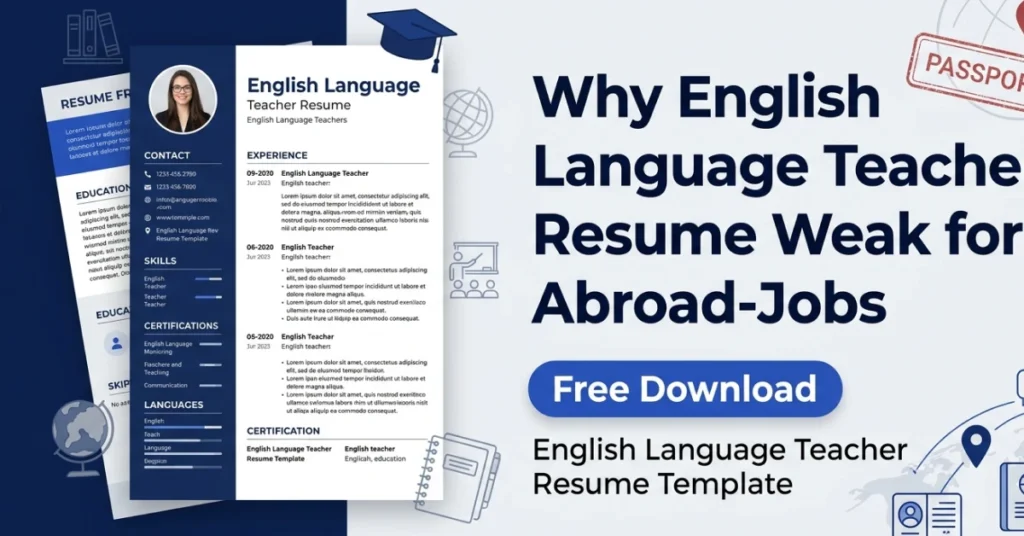
Some teachers write down the five skills and that’s it! Others give numbers of 30 and make the whole thing illegible! Both of these are not applicable to international hiring.
Limit yourself to 10-15 skills that are directly relevant to teaching English overseas. Properly include hard and soft skills. It emphasizes more on hard skills for international positions.
Strong skills to highlight include:
• Curriculum and lesson plan development
• IELTS / TOEFL / Cambridge exam preparation
• Business English and professional communication
• Online and blended learning delivery
• Classroom management across mixed-ability groups
• Phonics and early literacy instruction
• Student progress assessment and reporting
It is also worth reviewing how other service professionals structure their CVs to present personal and practical information clearly. Nursing assistant resumes do this particularly well. They lead with credentials and practical availability upfront. It is exactly what international teaching employers want to see.
Why Are You Sending the Same CV Everywhere?
A lot of educators compose their CVs and distribute them on every platform. The same never applies to international applications.
Read each job description carefully. Match your language to the words the employer uses. If they call it a “learning facilitator” role rather than a “teaching position,” reflect that in your CV.
The same logic applies when you compare it to other professional CVs. Roles that require both technical skill and personal presentation like a personal trainer resume always adapt their content to match what each client or employer needs. Treat your teaching CV the same way.
Conclusions
If you try getting shortlisted for international teaching jobs it is competitive. Schools and language academies across the world receive applications from qualified candidates every day and they make decisions quickly.An English Language Teacher Resume must be more diligent than a typical home resume. It needs to stand out clearly, demonstrate measurable results, and pass applicant tracking systems (ATS) while matching country-specific expectations.

Aleena Amin
This article was written by Aleena Amin. Explore more posts from this author for helpful insights and resources.